
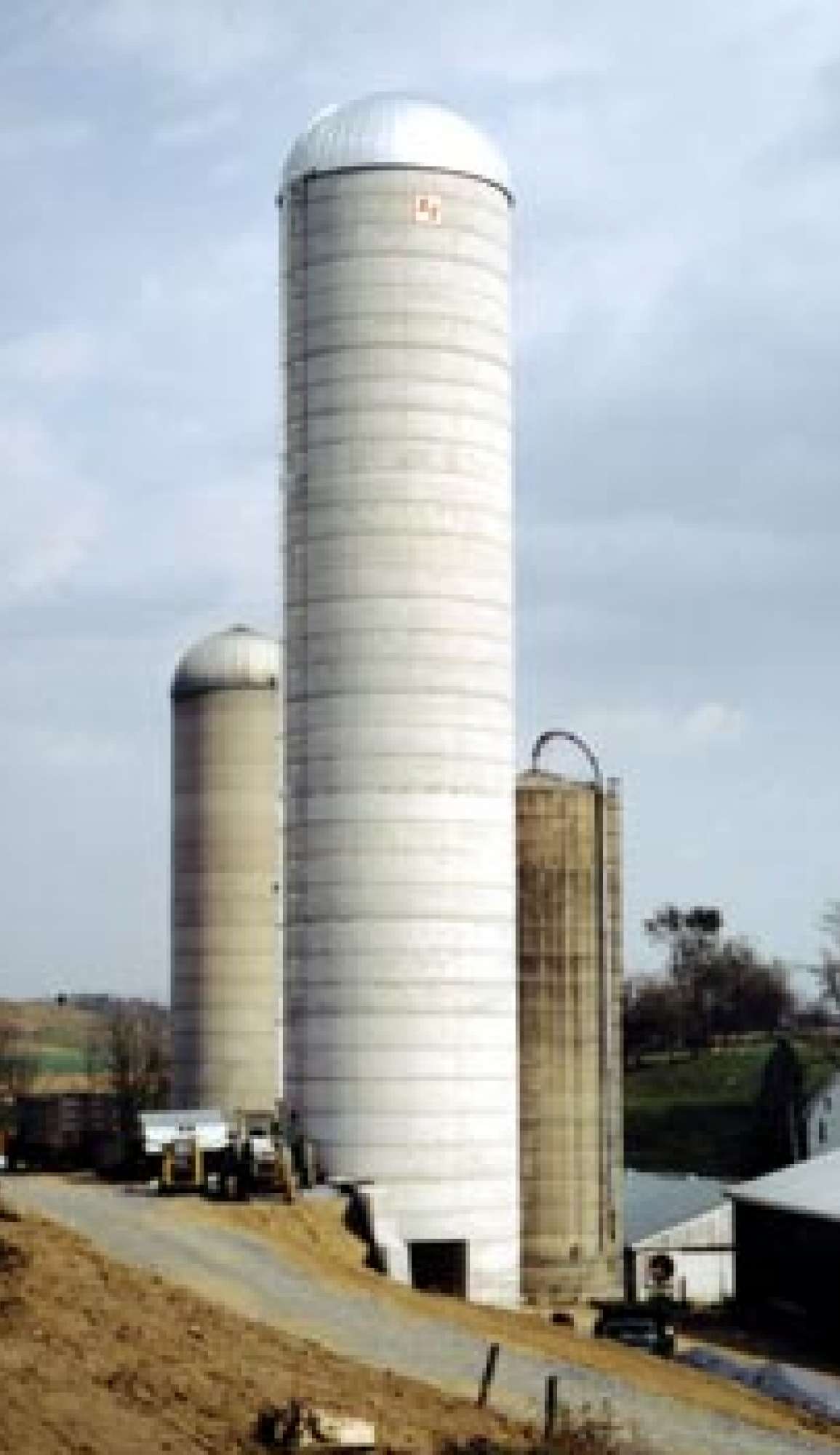
Largest Farm Silo In The Country
|
|
|
"ONE OF A KIND"
30' x 148'
Poured Concrete Silo
Big Jim Quantum Unloader
Elevated Floor for Drive-Thru
More than 90,000 cubic feet capacity (bigger than the Goodyear blimp)
Silage blower is located 20' above footer
Capacity will vary from 3,300 - 4,500 tons, depending upon moisture content, length of cut, filling rate, grain content of the silage, and growing conditions.
Located in Berks County, PA
|
|
"If you need a silo this large, it
must
be
Poured Concrete!"
|
Possibly the largest farm silo in the country!
30' x 148', located in Berks Co. PA
Equipped with an elevated floor with 12' clearance so feed truck can drive through and be quickly loaded. The silo is equipped with the Big Jim Quantum unloader, making the system capable of loading 50-plus tons per hour, and unloading 800 to 1200 pounds per minute. The silo has over 94,000 cubic feet of storage capacity, and should hold over 4,000 tons of corn silage. The total capacity will depend upon moisture content, length of cut, filling rate, grain content of the silage, and crop growing conditions.
The footer required 125 cubic yards of concrete; the silo with the drive-through tunnel required over 350 yards. There is over 9 miles of steel rebar in the total project.
We still build a lot of 16', 18', 20', and 24' diameter silos. The 20 ft. and larger silos can have the drive-thru option.
More and more producers are asking the question...
Why should I store my silage in a concrete tower silo?
3 Important Considerations:
1. Labor
-
Fill your tower silo at the rate of 50 tons per hour; faster than packing a bunker.
-
A 20,000 pound tractor can effectively pack 25 tons per hour in a bunker.
-
Let gravity
do the packing... no tractor and operator needed.
-
Drive-through option for maximum convenience.
-
Up to 70 lbs. per cu.ft. in a tower silo and only 35-45 lbs. per cu.ft. in a bunker.
-
Tighter pack means less oxygen in the pack.
2. Risk
-
Management is responsible to reduce or minimize RISK!
-
While in a tower silo, the feed is protected from rain, snow, ice, mud, wind and "critters".
-
The feed is protected while filling, during rain or inclement weather.
-
Feed is protected while feeding from storage.
-
Health risk to livestock is reduced, especially during warm winters and rainy seasons.
-
Reduced risk from mycotoxins.
3. Quality of the silage
-
Even the best managed bunkers will have at least 10% more loss than the tower silo.
-
This loss becomes even more significant if the crop has been damaged and reduced by drought.
-
Very high-producing cows are sensitive to feed quality.
-
Forage quality is the single most important factor affecting profit on most dairy farms.
-
It isn't what you plant, grow, harvest, and store; it's what comes out of storage that counts.
-
Oxygen, heat and the elements are three main causes of lowered feed quality in storage.
Remember...
When you fill a silo, you are not just storing silage or haylage: you are storing very expensive ration ingredients such as protein, energy, calcium, fiber, vitamins, etc. If you do not protect these valuable ingredients by proper storage, then the cost to replace them will be about double!
GRAVITY IS A WONDERFUL THING! USE IT TO YOUR ADVANTAGE IN YOUR FEED STORAGE AND DELIVERY SYSTEMS.
|